
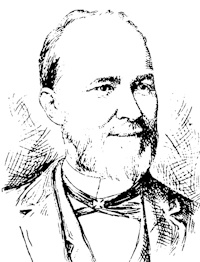
 Richard Libby Carne (5 October 1826–18 February 1911), educator, was born in Alexandria and was the son of Richard Levi Carne, a merchant, and Cecelia Latruite Shakes Carne. Educated at home by his mother until age nine because of his delicate constitution, Carne in 1835 entered Saint John's Academy, a Jesuit school recently established by the priests of Saint Mary's Catholic Church, his home parish in Alexandria. There he studied French, Greek, and Latin for five years before beginning to work in his father's hardware store. In 1847 the parish priest invited Carne to reopen Saint John's, which had closed in 1841, and to return as a teacher. In spite of having no formal training beyond his early study at the academy, Carne reorganized the school and was its principal teacher and administrator for the next forty-five years. He opened the revived Saint John's with one assistant and seven pupils. With occasional help from his younger brother, William Francis Carne, and his mother, the academy prospered, and by 1850 the school enrolled seventy-two students. It operated even during the Civil War and educated the sons of soldiers in both armies. In 1868 Georgetown College (later Georgetown University) awarded Carne an honorary A.M. in recognition of his accomplishments as an educator.
While continuing his duties at Saint John's Academy, Carne embraced a new role in 1870, when he became the first superintendent of the public schools of the city and county of Alexandria (later Arlington County). Virginia's first superintendent of public instruction, William Henry Ruffner, named experienced educators and respected local administrators such as Carne when establishing the new system of free public schools required by the Constitution of 1869. As a Catholic promoting public schools in a religiously mixed community, Carne was perhaps particularly sensitive to the challenge of finding the appropriate role of religion in the new system and sought to exclude Scriptures from the classroom. Ruffner essentially deferred to community desires about Bible reading and religious content in the local schools. Ironically, Carne's success in creating a respected public school system in Alexandria contributed to a steady loss of pupils at Saint John's Academy, which closed in 1895. Carne served as superintendent of the county's schools until 1880, when the management of the county system was given to a separate administrator, but he remained city superintendent until 1882. In that year, following the Readjuster Party's victory in the statewide and assembly elections, Carne's brother William F. Carne became city superintendent. After the Democratic Party regained the majority in the assembly and control of the executive branch, Richard L. Carne was reappointed superintendent of the city schools in 1886.
In 1892 Carne turned his life in a new direction. At age sixty-six, he left Saint John's Academy and public education and entered the priesthood, fulfilling a lifelong calling for which he had intermittently studied since age fifteen. The bishop of the Diocese of Richmond ordained him at Saint Mary's Catholic Church in Alexandria on 1 November 1892. Carne was assistant pastor at the Sacred Heart Catholic Church in Richmond from 1893 to 1895 and then chaplain at the Old Point Comfort College in Fort Monroe in 1903 and 1904. Returning to Alexandria about 1907 to live with his sister and brother-in-law, Carne served as a chaplain to the Catholic community there and for Saint Mary's Academy. After more than a week in a coma Richard Libby Carne died in Alexandria on 18 February 1911 and was buried in the cemetery of Saint Mary's Catholic Church.
Sources Consulted: Biographies in Virginia School Journal 1 (1892): 215 (portrait), and St. Mary's: 200 Years for Christ, 1795–1995 (1995), 181–182 (portrait); some Carne correspondence, including autobiographical letter to Charles Macksey, 12 Jan. 1906, in Georgetown University Archives, Washington, D.C.; works include Carne, A Brief Sketch of the History of St. Mary's Church, Alexandria, Va. (1874), and farewell address to Saint John's Academy, in Academy Journal 23 (Aug. 1892): n.p.; Saint John's Academy Records, Alexandria Public Library; pastoral assignments provided by Office of Archives, Catholic Diocese of Richmond (2003); obituaries in Washington Post and Washington Sunday Star, both 19 Feb. 1911, the latter reprinted in part in Georgetown College Journal (Mar. 1911), 325–326; obituary and account of funeral in Alexandria Gazette, 20 Feb. 1911, 22 Feb. 1911.
Engraving in Virginia School Journal 1:215.