
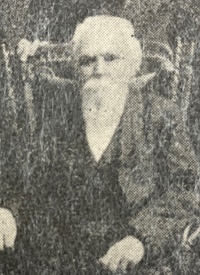
 William Francis Carne (17 August 1832–20 December 1909), journalist and writer, was born in Alexandria and was the son of Richard Levi Carne, a merchant, and Cecelia Latruite Shakes Carne. He worked as a clerk in his father's hardware store and early in the 1850s assisted his elder brother, Richard Libby Carne, in reviving Saint John's Academy, a Jesuit boys' school in Alexandria associated with Saint Mary's Parish. Carne also studied law, received a license to practice in 1857, and joined a local firm. Despite his employment as an attorney and teacher, journalism and writing were his passions. In his diary on 9 September 1853, he cheerfully recorded an auspicious event, his first receipt of financial compensation for his writing.
Carne worked in a variety of capacities on several local journals, for newspapers published in Baltimore and Washington (among them the Washington Evening Star and the Washington National Republican), and for a brief time in New York. His Alexandria residence positioned him well to cover the national government as a Washington correspondent for the Baltimore Sun for more than a quarter of a century beginning in 1871. Although Carne expended the greater part of his journalistic energies reporting on the nation's capital, he also researched and wrote about the history on the south side of the Potomac River.
Carne's most frequent subject was the colonial and Revolutionary history of northern Virginia, with particular interest in the life of George Washington, whom he regarded as a model and a hero. He wrote frequently about Washington for a variety of audiences. Among his publications were "Washington as a Burgher" for Harper's New Monthly Magazine and "A New Leaf From Washington's Boy Life" for St. Nicholas, a children's magazine. Carne also used Washington's life as a measure by which to assess and defend an important and controversial public figure of his own lifetime, Robert Edward Lee, in an essay entitled "Washington's Example" for the Fairfax Herald of 26 October 1900.
Beginning in 1860 and continuing through the 1870s, Carne wrote an extended series of articles entitled "Annals of Alexandria" for the Alexandria Gazette. The first installment appeared at a time when sectional tensions were intense and the nation took renewed interest in its Revolutionary origins. In the "Annals" and elsewhere, as in "Washington's Catholic Aide-de-Camp," published in Catholic World, Carne was particularly attentive to the role of Catholics in the early history of the region. The "Annals of Alexandria" articles served as the source for several short historical essays that he wrote on the history of the city and that were published in 1983 in a collected edition. As both an attorney and a local historian, Carne was the logical choice of the Alexandria town council to compile a revised edition of the town's code, which was enacted in December 1873 and published the following year with a brief history of Alexandria local government; and on 9 March 1880 he delivered the oration at the centennial celebration of the incorporation of the town. In addition to his historical writing, Carne produced several other publications, including a brief romantic tale of colonial days, Narrative of John Trust (1883), sometimes called Story of the Female Stranger, which he reprinted in a short History of Alexandria in 1896. He also published the Alexandria Business Book (1897), a promotional work that included a directory of local businesses, a history of the city, and an account of the city's contemporary economic life.
For most of his life Carne was a Democrat, but during the 1880s he supported the Readjusters, perhaps because of that party's concern for the state's public school system, which had been created in 1870. That political affiliation led to his appointment in 1882 as superintendent of the Alexandria city schools. He replaced his brother Richard L. Carne, who had been superintendent since 1870 and remained loyal to the Democratic Party. After the Democrats regained control of the state government, they replaced the Readjuster superintendents with Democrats. In 1886 Carne relinquished the office to his brother, who resumed his former work on behalf of public education, to which they were both committed.
On 21 May 1861 Carne married Emma Virginia Markell. They had one son and two daughters, one of whom died in infancy, before his wife's death on 4 March 1874. He married Cornelia A. Stoutenburgh on 10 August 1875. They had one son and one daughter. William Francis Carne died at his home in Alexandria on 20 December 1909 and was buried in the graveyard at Saint Mary's Catholic Church.
Sources Consulted: Biography in T. Michael Miller, ed., Alexandria's Forgotten Legacy: The Annals of Wm. F. Carne (1983), iii–viii; birth date in baptismal record, Saint Mary's Catholic Church, Alexandria, printed in St. Mary's: 200 Years for Christ, 1795–1995 (1995), 236; Marriage Register, Arlington Co. (formerly Alexandria Co.), 1861, Alexandria City, 1875, Bureau of Vital Statistics, Commonwealth of Virginia Department of Health, Record Group 36, Library of Virginia; William F. Carne Diary (1853–1854), Alexandria Public Library; publications include The Charter and Laws, of the City of Alexandria, Va., and an Historical Sketch of Its Government (1874), "Centennial Oration," in Celebration of the First Centennial of the Municipal Government of the City of Alexandria, Virginia (1880), 24–46, "Washington as a Burgher," Harper's New Monthly Magazine 60 (1880): 353–365, "A New Leaf From Washington's Boy Life," St. Nicholas 14 (1887): 373–375, and "Washington's Catholic Aide-de-Camp," Catholic World 50 (1890) 437–445; Alexander J. Wedderburn, Souvenir Virginia Ter Centennial of Historic Alexandria, Va., Past and Present (1907), portrait on unnumbered page 76; obituaries in Alexandria Gazette, 21 Dec. 1909 (with editorial tribute), Baltimore Sun, 22 Dec. 1909, and Fairfax Herald, 24 Dec. 1909.
Photograph in Wedderburn, Souvenir Virginia Ter Centennial of Historic Alexandria, Va. (1907), on unnumbered page 76.