
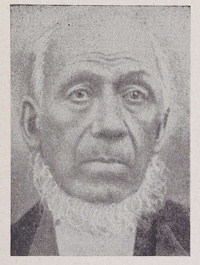
 Charles E. Hodges (May 1819–after 15 April 1910), member of the House of Delegates, was born in Princess Anne County and was the son of Charles Augustus Hodges and his second wife, Julia Nelson Willis Hodges, both free African Americans of mixed-race ancestry. His middle name may have been Edward. The Hodges family was one of the more prosperous of the numerous free Black families in Princess Anne County (later the city of Virginia Beach). Hodges's father purchased three farms and his own father's freedom, and he also arranged for private tutors to teach his children how to read and write. Hodges's older brother Willis Augustus Hodges served in the Convention of 1867–1868, his nephew John Quincy Hodges served in the House of Delegates, and his older brother William Johnson Hodges had a long career in New York as an antislavery activist and a short career in Virginia as an African American political leader after the Civil War.
Hodges's brothers, William Johnson and Willis Augustus, were living in Brooklyn, New York, when their father drafted a will late in 1843 and in it left his farm to Charles Hodges. Shortly after their father's death, Willis Hodges returned to Princess Anne County to live with his brother and mother and manage the family farm. In December 1844 Willis Hodges was accused of preaching abolitionist doctrines, and he and Charles Hodges were arrested on a disturbing the peace charge, but in the absence of evidence against them the county court dropped the charge.
Hodges's name does not appear in the pre–Civil War official marriage records for Princess Anne County, but in the mid-1840s he married Sarah Harmon, who may have been a widow with a son. They had at least two sons and two daughters before she died sometime in the 1860s. In February 1850 Hodges was swindled out of the property he had inherited from his father, of whose estate he was the executor. At that time he was paying taxes on two tracts containing altogether 143 acres of land worth more than $500. A local lawyer told him that he would not be able to recover it and would be better advised to leave the state. Under death threats early in 1851 Hodges and his family, including his mother and perhaps some of his younger siblings, joined his brothers in Brooklyn, where they lived until the mid-1860s. While there he worked for the post office and became a Baptist minister, as had both his brothers, and he joined them in taking part in public antislavery meetings. In August 1864 he presided at a meeting of African Americans that condemned a proposal to resettle freed women and children in New York because they were to be employed as servants.
Hodges moved back to Virginia, perhaps even before the end of the Civil War. In the spring of 1866 he and his brothers appealed to an agent of the army's Bureau of Refugees, Freedmen, and Abandoned Lands to allow their mother to reclaim her dower rights to her husband's property that he had lost in the swindle of 1850, but they were unsuccessful. Already well known in Princess Anne County and Norfolk, the three brothers quickly emerged as local leaders in the African American community. The Norfolk County Court licensed Hodges to perform marriages in March 1869. On 6 July 1869 he won election to a two-year term as one of three members of the House of Delegates to represent Norfolk County, which included the city of Portsmouth. The three victorious candidates all received more than 3,500 votes, the three defeated candidates between 2,100 and 2,200. Hodges received the third-highest number of votes, 3,529. His nephew John Quincy Hodges won election that same day to represent Princess Anne County.
In the first sessions Hodges attended he served on the Committee on Public Property and on the Committee on Banks, Currency, and Commerce, and in the final session in 1870–1871 on the Committees on Labor and Poor and on Public Property. In the brief October 1869 special session Hodges voted to ratify the Fourteenth and Fifteenth Amendments as Congress required before it seated senators and representatives from Virginia. On 29 June 1870 he voted for a motion to delete a provision to require racial segregation from the bill to establish the first statewide system of public schools in Virginia. The motion did not pass. Two days later Hodges joined most of the other African American delegates in voting against passage of the bill as a measure of protest against enforced segregation. The other bill of long-term importance for which Hodges voted was the Funding Act of 1871, which passed the House of Delegates in March of that year and committed the state to paying its pre-Civil War debt. He and most other African American legislators voted for it. That law, unfortunately, made it difficult for the state to appropriate adequate money for the public schools and led to more than a decade of severe budget problems for the state government and prolonged political turmoil. The General Assembly redrew legislative districts in 1871 and separated Portsmouth from Norfolk County. Hodges did not seek reelection.
The 1870 census return identified Hodges as a clergyman, although subsequent census returns identified him as a farmer. He was an elder in the Roanoke Missionary Baptist Association, which included churches in northeastern North Carolina and in southeastern Virginia, and was a founder of a relief society for the widows and orphans of the association's ministers. He reportedly donated land for a church, which he also served as pastor, near Lake Drummond in southern Norfolk County (later the city of Chesapeake). On 22 May 1873 he won election for a three-year term as a justice of the peace in Norfolk County. The office of justice of the peace was no longer an influential one as it had been during previous centuries. Hodges acted as a petty magistrate only and did not preside over a court of record. He did not prosper. In 1873 he borrowed or co-signed a note for more than $150 that he was unable to repay. The creditors sued but never recovered the money.
During the 1870s Hodges married a second time. The 1880 census named his wife Lucretia, age fifty-five, but records do not indicate when or where they married or when she died. On 25 September 1888 Hodges, at the time a clergyman living in Princess Anne County, married Fannie E. Griffin, who was about forty-eight years old. They probably had no children, but the 1910 census recorded Clarence Burrough, age eleven, and Lloyd Hodges, age seven, living with them in Princess Anne County. Charles E. Hodges died sometime after 15 April 1910, the official date of the decennial census, but the date of his death and place of burial are not known.
Sources Consulted: Biography in Luther Porter Jackson, Negro Office-Holders in Virginia, 1865–1895 (1945), 21, 31 (portrait); birth date in Charles E. Hodges's April 1866 deposition about loss of property in Julia Hodges v. James Bonney, enclosed in Thomas P. Jackson to A. S. Flagg 10 Apr. 1866, Records of the Field Offices for the State of Virginia (1865–1872), Norfolk Subdivision, Letters Received, March–June 1866, Bureau of Refugees, Freedmen, and Abandoned Lands, Record Group 105, M1913, Roll 141, National Archives and Records Administration (NARA), Washington, D.C.; wives and children documented in United States Census Schedules, Princess Anne Co., VA, 1850, 1900 (with May 1819 birth date), 1910 (last known mention on 15 April), Kings Co., New York, 1860, Norfolk Co., VA, 1870, 1880, Records of the Bureau of the Census, Record Group 29, NARA; third marriage in Marriage Register, Norfolk Co., Bureau of Vital Statistics, Commonwealth of Virginia Department of Health, Record Group 36, Library of Virginia, and reported in Norfolk Virginian, 30 Sept. 1888; family history in Willard B. Gatewood Jr., ed., Free Man of Color: The Autobiography of Willis Augustus Hodges (1982); General Orders and Circulars, Headquarters First Military District, 1869 (1870), "Summary of the result of the election for members of the House of Delegates of Virginia, held on the 6th day of July, 1869," 24; Richmond Daily Dispatch, 7 July, 10 July 1869; Norfolk Journal, 7, 8 July 1869; Charles Hodges v. Willis Hodges, Princess Anne Co. Chancery Causes, 1851-033, LVA; lawsuit against Hodges in R. J. Neely, William Neely, and John R. Neely v. Charles E. Hodges and Lydia A. Williams, Norfolk Co. Chancery Causes, 1888-044, LVA; license to perform marriages in Norfolk Co. Minute Book 36:167; Private Laws of the State of North Carolina…1869–'70 (1870), 2:152–153; Proceedings of the Baptist State Convention of North Carolina…1875 (1875), 22.
Photograph in Jackson, Negro Office-Holders in Virginia, 1865–1895 (1945), 31.