
Death or Liberty: Gabriel, Nat Turner and John Brown
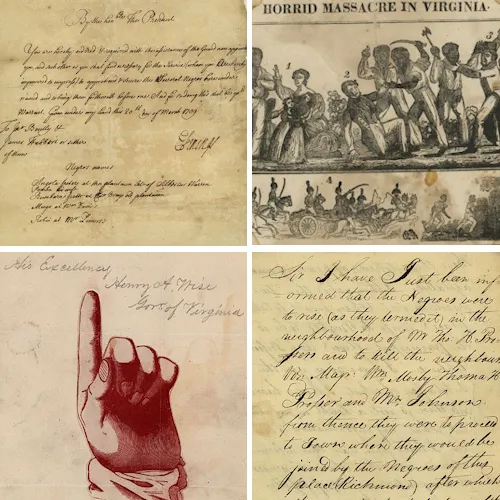
On display from January 10–November 8, 2000, “Death or Liberty: Gabriel, Nat Turner and John Brown” included documents from the Library's collections to examine pivotal events and debates about slavery, freedom, and sectional politics that raged in their wake as well as how the public memory of these events changed over time.
Between the Revolution and the Civil War, three dramatic events in Virginia focused America’s attention on slavery. Gabriel’s Conspiracy in 1800, Nat Turner’s Rebellion in Southampton County in 1831, and John Brown’s Raid on Harpers Ferry in 1859 deeply shocked white southerners and provided confirmation for those who argued that slavery was incompatible with American liberty.
African American scholar and activist W.E.B. Du Bois once noted that the attitudes of an “imprisoned” group could take three forms: “a feeling of revolt and revenge; an attempt to adjust all thought and action to the will of the greater groups; or, finally, a determined attempt at self-development, self-realization, in spite of envisioning discouragements and prejudice.” These attitudes ebbed and flowed with the “spirit of the age.”
The spirit of revolt exhibited by Gabriel in 1800 and Nat Turner in 1831 convinced John Brown in 1859 that the enslaved people across the South were ready and willing to emancipate themselves. All they needed, Brown concluded, was the moral and military guidance of an inspired leader.
Resistance to the State
Insurrections were not unknown in America before the Revolution. A 1739 uprising by enslaved people near Charleston, South Carolina, known as “Cato’s Conspiracy” or the “Stono Rebellion,” culminated in the deaths of 30 whites and 44 Blacks. Reports of a “Great Negro Plot” in New York, based on the sensational testimony of a white indentured servant, led to the convictions of more than 100 African Americans in 1741. In Virginia, African Americans joined with white servants as early as 1663 to rebel and gain their freedom.
By the early eighteenth century, however, Virginia’s decisive turn toward slavery made revolt a largely Black versus white issue. Enslaved African Americans posed a constant threat to the security of their white owners, particularly in times of war. “The Villany of the Negroes in any Emergency of Gov’t is [what] I always feared,” Lieutenant Governor Robert Dinwiddie declared in 1755 as French and Indian troops fought British colonial forces in Virginia. Isolated insurrections and reports of conspiracies kept white authorities on edge throughout British colonial America.
By the early 1800s slave resistance took many forms, with open and organized revolt by large groups of enslaved people only the most extreme example. Some enslaved individuals attempted to “steal” their own labor by feigning illness, shirking work, or running away. Some engaged in the deliberate destruction of property, perhaps breaking an expensive tool or setting a barn on fire. Some went so far as to plot the deaths of their owners; poisonings at the hands of trusted house servants were widely suspected, but rarely proved. Even learning to read, which was prohibited by law, was an act of resistance. While open rebellion was rare, the threat was real to white southerners and Virginians. Scarcely a year passed without rumors of a plot to stage an insurrection. The papers of Virginia’s governors contain constant pleas from Virginia militia units for weapons to respond to threats of rebellion.
Related Documents
A "Dangerous Conspiracy" among enslaved Africans and Indians in the vicinity of Surry and Isle of Wight Counties came to light in the spring of 1709. Two enslaved men, an Indigenous man named Salvadore and an African man named Scipio were tried in the colony's General Court and sentenced to execution in 1710. These documents from the records of the Governor's Council describe the measures taken in Surry and Isle of Wight Counties to uncover the conspiracy and punish some of its participants.
In 1781, an enslaved man named Billy escaped slavery, but was captured and convicted of treason for aiding the British. His life was spared when white men petitioned for his pardon on the grounds that an enslaved man was not a citizen and therefore could not commit treason.
In the summer of 1829, fears of a rebellion by enslaved people in Gloucester and Mathews Counties led the local militias to request weapons from the state arsenal. Such requests were not uncommon and in this case the governor authorized arms to be disbursed, although no insurrection occurred. These letters to Gov. William B. Giles describe the fears of white Virginians.
A group of enslaved people who had escaped the Eastern Shore to New York were captured and tried in Northampton County for stealing the whaleboat they used to escape in 1832. These documents from Gov. John Floyd's Executive Papers include an affidavit listing those who escaped and a deposition by the whaleboat's owner.
Gabriel's Conspiracy

On August 30, 1800, a tremendous storm dropped heavy rain on central Virginia, swelling creeks and turning Richmond’s dirt streets into quagmires. The storm aborted one of the most extensive plots by enslaved people in American history, a conspiracy known to hundreds of slaves throughout central Virginia. A charismatic blacksmith named Gabriel, who was enslaved by Thomas Prosser, of Henrico County, planned to enter Richmond with force, capture the Capitol and the Virginia State Armory, and hold Governor James Monroe hostage to bargain for freedom for Virginia’s enslaved people. The intensity of the storm delayed the conspirators’ planned gathering, and a few nervous conspirators told their white enslavers of the plot. The arrests of the conspirators, including Gabriel, led to trials in Richmond, Petersburg, Norfolk, and several surrounding counties. The conspirators were tried in courts of oyer and terminer, established under a 1692 statute in which testimony was heard by five justices, not a jury, with appeal only to the governor. Twenty-six slaves were hanged, and another apparently committed suicide in his cell. Several of those convicted were sold and transported out of Virginia. Two men, who had informed their enslavers about the intended rebellion, received their freedom.
Historian Douglas R. Egerton definitively places the insurrection within the context of post-Revolutionary Virginia, when Democratic-Republicans and Federalists argued about the proper extent of liberty and debated the legacies of the French, American, and even the Haitian, Revolutions. Learning from these debates, Gabriel based his actions on conceptions of freedom and liberty that flowed from the revolutionary movements. At Gabriel’s trial, Ben Woolfolk, who had been recruited by Gabriel, testified that Gabriel intended to "purchase a piece of silk for a flag on which they would have written ‘death or liberty’"—a clear reference to Patrick Henry’s fiery speech of 1775. If white Richmonders agreed to free the enslaved people, according to one conspirator, Gabriel “would dine and drink with the merchants of the City.” One insurgent reputedly stated that “I have nothing more to offer than what General Washington would have had to offer, had he been taken by the British and put to trial.”
Gabriel’s Conspiracy had an immediate impact on American politics and Virginia law and society. The planned rebellion was widely reported in American newspapers, and, during the 1800 presidential campaign, the Federalists cited the event as a consequence of the Democratic-Republicans’ support of the French Revolution and ultrademocratic ideals. The intense scrutiny made some of Virginia’s leaders uncomfortable with the execution of the revolutionaries. Monroe, a participant himself in a war for liberty, expressed concern about the number of executions. Thomas Jefferson agreed that “there is a strong sentiment that there has been hanging enough. The other states & the world at large will forever condemn us if we indulge in a principle of revenge.” In the wake of the affair, however, Virginia’s lawmakers imposed new restrictions on slaves and free Blacks. Whites would never again be complacent about the possibility of slave uprisings.
Nat Turner’s Rebellion

On August 23, 1831, Governor John Floyd received a hastily written note from Southampton County postmaster James Trezvant stating “that an insurrection of the slaves in that county had taken place, that several families had been massacred and that it would take a considerable military force to put them down.” Fifty-seven whites, many of them women and children, died before a massive force of militiamen and armed volunteers could converge on the region and crush the insurrection. Angry white vigilantes killed dozens of slaves and drove hundreds of free persons of color into exile in the reign of terror that followed.
Early newspaper reports identified the Southampton insurgents as a leaderless mob of runaway slaves that rose out of the Dismal Swamp to wreak havoc on unsuspecting white families. Military leaders and others on the scene soon confirmed that the insurgents were not runaways but, rather, enslaved people from local plantations. Reports of as many as 450 Black insurgents gave way to revised estimates of perhaps 60 armed men and boys, many of them coerced into joining. The confessions of prisoners and the interrogation of eyewitnesses pointed to a small group of ringleaders: a free man of color named Billy Artis, a celebrated enslaved man known as “Gen. Nelson,” and an enslaved preacher by the name of Nat Turner. Attention focused on Turner; it was his “imagined spirit of prophecy” and his extraordinary powers of persuasion, local authorities reported, that had turned obedient slaves into bloodthirsty killers. Turner’s ability to elude capture for more than two months only enhanced his mythic stature.
While Nat Turner remained at large, rumors of a wider conspiracy flourished. An abolitionist writer named Samuel Warner suggested that Turner had hidden himself in the Dismal Swamp with an army of runaways at his disposal. State officials took pains to ensure that Turner lived to stand trial by offering a $500 reward for his capture and safe return to the Southampton County jail. On October 30, 1831, Turner surrendered to a local farmer who found him hiding in a cave not far from the place where Turner lived. Local planter and lawyer Thomas R. Gray interviewed Turner in his jail cell, recorded his “Confessions,” and published them as a pamphlet shortly after Turner was tried, convicted, and executed. In tracing the “history of the motives” that led him to undertake the insurrection, Turner insisted that God had given him a sign to act, that he had shared his plans with only a few trusted followers, and that he knew nothing of any wider conspiracy extending beyond the Southampton County area. Certified as authentic by six local magistrates and said to be authorized by Turner himself, the “Confessions” became the definitive source for nearly all subsequent accounts of the event.
Nat Turner’s revolt prompted a prolonged debate in the Virginia General Assembly of 1831–1832. While many statesmen adhered to the Jeffersonian idea that the ending of slavery was desirable, no coherent plan for eventual abolition emerged. In fact, Virginia’s sponsorship of colonization to Africa, a popular solution to the problem, in reality became simply a way to remove free Blacks, who were thought to be a bad influence on enslaved people. Instead of advocating freedom, some prominent Virginians developed a positive argument for slavery’s good based on their readings of the Bible and classical history. As a result of Turner’s actions, Virginia’s legislators enacted more laws to limit the activities of African Americans, both free and enslaved. The freedom of enslaved people to communicate and congregate was directly attacked. No one could assemble a group of African Americans to teach reading or writing, nor could anyone be paid to teach an enslaved. Preaching by enslaved people and free Blacks was forbidden.
John Brown’s Raid

"The crimes of this guilty land will never be purged away but with blood."
—John Brown, December 2, 1859
On October 16, 1859 John Brown led eighteen men—thirteen whites and five Blacks—into Harpers Ferry, Virginia. Three other members of his force formed a rearguard at a nearby Maryland farm. A veteran of the violent struggles between pro- and antislavery forces in Kansas, Brown intended to provoke a general uprising of African Americans that would lead to a war against slavery. The raiders seized the federal buildings and cut the telegraph wires. Expecting local enslaved people to join them, Brown and his men waited in the armory while the townspeople surrounded the building. The raiders and the civilians exchanged gunfire, and eight of Brown’s men were killed or captured.
By daybreak on 18 October, U.S. Marines under the command of Brevet Colonel Robert E. Lee stormed Brown’s position in the arsenal’s enginehouse and captured or killed most of his force. Five of the conspirators, including Brown’s son Owen, escaped to safety in Canada and the North. Severely wounded and taken to the jail in Charles Town, Virginia, John Brown stood trial for treason against the commonwealth of Virginia, for murder, and for conspiring with slaves to rebel. On November 2, a jury convicted him and sentenced him to death. Brown readily accepted the sentence and declared that he had acted in accordance with God’s commandments. Responding to persistent rumors and written threats, Henry A. Wise, governor of Virginia, called out state militia companies to guard against a possible rescue of Brown and his followers. On December 2, 1859, Brown was hanged in Charles Town.
The Harpers Ferry raid confirmed for many Southerners the existence of a widespread Northern plot against slavery. In fact, Brown had raised funds for his raid from Northern abolitionists. To arm the slaves, he ordered one thousand pikes from a Connecticut manufactory. Letters to Governor Wise betrayed the mixed feelings people held for Brown. For some, he was simply insane and should not be hanged. For others, he was a martyr to the cause of abolition, and his quick trial and execution reflected the fear and arrogance of Virginia’s slave owners. Many Northerners condemned Brown’s actions but thought him right in his conviction that slavery had to end. Brown’s raid on Harpers Ferry and his execution further polarized North and South and made a resolution of the slavery issue the center of national debate.
Related Documents
Governor Wise left Richmond for Harpers Ferry as soon as he received word of the raid. Fearing further attacks on Virginia, he armed the local militia and sought the return of John Brown's weapons from the Maryland militia who helped put down the raid. He also placed a bounty of $500 each on men who escaped capture during the raid.
Governor Wise received correspondence from people around the country who demanded that John Brown receive a fair trial.
Even before John Brown was sentenced to death, Governor Wise and other government officials received warnings that executing him would make Brown a martyr for the abolitionist cause.
Governor Wise received personal warnings and threats that he would be in danger for executing John Brown.
Souvenir seekers wrote Governor Wise to request a memento of the famous abolitionist, while others capitalized on Brown's fame.
Remembering Revolt
Reactions to these three events contributed to the growing debate about slavery and its role in American society. White Virginia authors used both Gabriel’s proposed and Nat Turner’s successful rebellions as background events in novels such as The Old Dominion, Judith, and Their Shadows Before to perpetuate their belief that slavery was ultimately benign, that enslaved people were loyal, and that literacy, uncontrolled religion, and outside influences all threatened the stability of Virginia society. In contrast, Black Virginians immortalized the story of Gabriel in song and tale, occasionally blending Gabriel with other revolutionaries, such as Denmark Vesey of South Carolina and Nat Turner, and Black writers such as Martin Delany (Blake, 1858) and Arna Bontemps (Black Thunder, 1936) used the stories of these enslaved revolutionaries to emphasize themes of struggle and liberation.
The main actors in these powerful events remain shrouded in controversy, as does their larger meaning. The debate over their true legacy continues today. Even the words we use to describe these actions and the men who led them are loaded with contradictory meanings. Were Gabriel, Nat Turner, and John Brown freedom fighters or violent extremists? Were they inspired by a deep Christian faith or were they religious zealots and fanatics? And what of those who crushed these movements and executed their leaders? The many songs, novels, monuments, and historical markers that have been inspired by these conflicts tell of the enduring need for Americans to find meaning in these events.